How Does Solid Wood Behave? What's Normal and What to Watch For
Solid wood is a living material – and that's not just a poetic way of putting it. Even after being cut and dried, wood continues to respond to its environment: it exchanges moisture with the air around it, expands and contracts slightly with the seasons, and deepens in colour over time. Most of the things that worry new table owners are completely normal behaviour, not defects.
Below we explain what is really going on with your table.
- Solid wood responds to humidity throughout its entire life – it contracts slightly in dry air and expands in humid conditions.
- Small cracks running along the grain, minor changes in the width of the tabletop, and a gradual shift in colour are all natural parts of this process and don't indicate a fault.
- The only things worth taking seriously are cracks running across the grain, permanent warping of the top, or the finish lifting over a large area.

Wood Movement – Why Your Table Lives with the Seasons
Wood is hygroscopic – it absorbs and releases moisture from the surrounding air. When the air in your home becomes dry (typically in winter with central heating running), wood releases moisture and contracts slightly. When humidity rises, it reabsorbs it and expands.
In practice, this means a tabletop can change its dimensions by a few millimetres between summer and winter. This isn't a cause for concern – a well-made table is designed to accommodate this movement without damaging the joints. That is why solid wood tables use specially designed top fixings that allow the wood to move freely.
What helps wood move calmly
- Keep indoor humidity between 45–60% – a humidifier in winter makes a real difference.
- Avoid placing the table directly next to a radiator or in strong, direct sunlight.
- Don't wash the top with large amounts of water – moisture absorbed unevenly from one side can cause warping.
Wood Movement – Why Your Table Lives with the Seasons
Wood is hygroscopic – it absorbs and releases moisture from the surrounding air. When the air in your home becomes dry (typically in winter with central heating running), wood releases moisture and contracts slightly. When humidity rises, it reabsorbs it and expands.
In practice, this means a tabletop can change its dimensions by a few millimetres between summer and winter. This isn't a cause for concern – a well-made table is designed to accommodate this movement without damaging the joints. That is why solid wood tables use specially designed top fixings that allow the wood to move freely.
What helps wood move calmly
- Keep indoor humidity between 45–60% – a humidifier in winter makes a real difference.
- Avoid placing the table directly next to a radiator or in strong, direct sunlight.
- Don't wash the top with large amounts of water – moisture absorbed unevenly from one side can cause warping.
Wood Movement – Why Your Table Lives with the Seasons
Wood is hygroscopic – it absorbs and releases moisture from the surrounding air. When the air in your home becomes dry (typically in winter with central heating running), wood releases moisture and contracts slightly. When humidity rises, it reabsorbs it and expands.
In practice, this means a tabletop can change its dimensions by a few millimetres between summer and winter. This isn't a cause for concern – a well-made table is designed to accommodate this movement without damaging the joints. That is why solid wood tables use specially designed top fixings that allow the wood to move freely.
What helps wood move calmly
- Keep indoor humidity between 45–60% – a humidifier in winter makes a real difference.
- Avoid placing the table directly next to a radiator or in strong, direct sunlight.
- Don't wash the top with large amounts of water – moisture absorbed unevenly from one side can cause warping.
Wood Movement – Why Your Table Lives with the Seasons
Wood is hygroscopic – it absorbs and releases moisture from the surrounding air. When the air in your home becomes dry (typically in winter with central heating running), wood releases moisture and contracts slightly. When humidity rises, it reabsorbs it and expands.
In practice, this means a tabletop can change its dimensions by a few millimetres between summer and winter. This isn't a cause for concern – a well-made table is designed to accommodate this movement without damaging the joints. That is why solid wood tables use specially designed top fixings that allow the wood to move freely.
What helps wood move calmly
- Keep indoor humidity between 45–60% – a humidifier in winter makes a real difference.
- Avoid placing the table directly next to a radiator or in strong, direct sunlight.
- Don't wash the top with large amounts of water – moisture absorbed unevenly from one side can cause warping.
Microcracks – When They're Normal and When They're Not
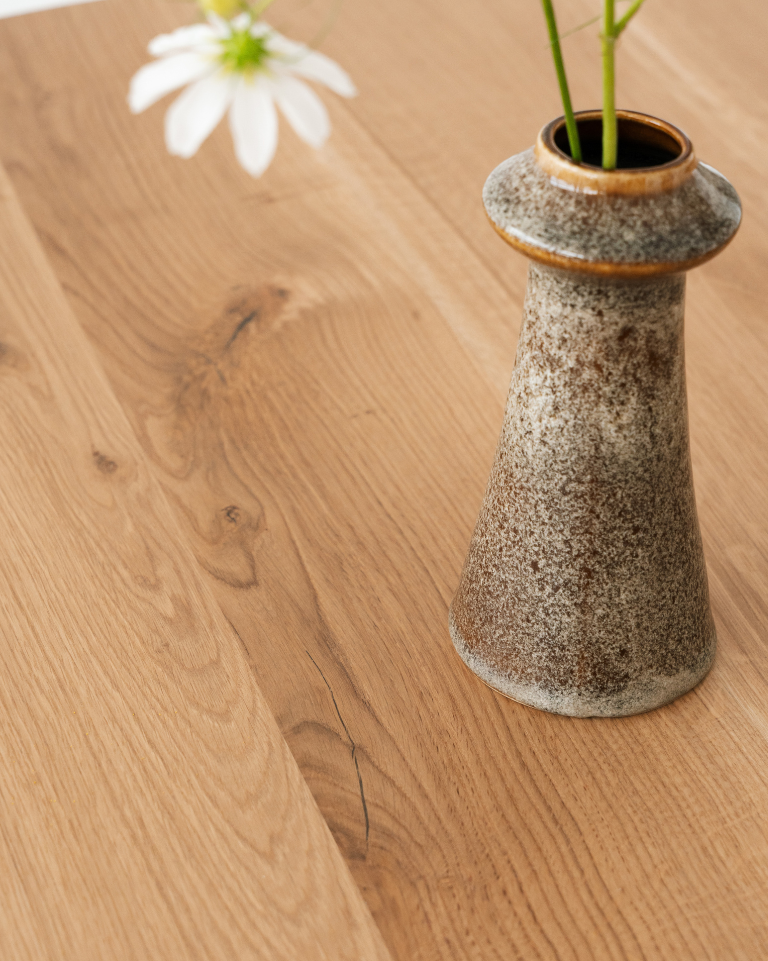
Small cracks along the grain are one of the most common concerns after a table arrives. In most cases, they're a completely natural characteristic of solid wood, not a defect.
Wood cracks along its fibres when it loses moisture faster than it can release it evenly – most commonly at the start of the heating season when indoor humidity drops suddenly. These cracks are typically a few centimetres long, shallow, and follow the direction of the grain.
What is normal
- Small, shallow cracks running with the grain – especially in the first year of use.
- Cracks that appear in winter and partially close again in summer.
- Slight gaps between boards in very dry conditions.
When is it worth taking a look
- Cracks running across the grain – these can indicate a structural issue with the wood.
- A crack that deepens or widens rapidly.
- Permanent warping or twisting of the entire top.
Colour Change – Patina, Not Damage
Solid wood changes colour over the years, and this is one of its greatest qualities, not a flaw. Oak gradually darkens and takes on a warmer, honey-like tone. American walnut – very dark at first – lightens slightly and evens out over time. Ash develops a gentle golden warmth in areas exposed to light.
The reaction to UV light is particularly visible. If a placemat or decoration sits in the same spot for a long time, removing it may reveal a colour difference. This isn't a stain – it's the natural ageing of wood at different rates. Given equal exposure to light, the colour will even out over time.
What is worth remembering
- Avoid prolonged direct sunlight on the top – UV accelerates ageing unevenly.
- Oil-wax finish enhances the natural evolution of colour; lacquer slows it down slightly.
- The patina on an older table is a mark of quality – it shows the furniture is made from the real thing.
What to Expect After Delivery
The first few months are an acclimatisation period, as the table settles into the conditions of your home. Wood that arrives in a new environment needs time to stabilise its moisture content – especially if your home is significantly drier or more humid than the workshop it came from.
During this period, small cracks or minor dimensional changes may appear. They don't require any intervention – after a few weeks the table finds its equilibrium and things settle down.
If after the first heating season you have any doubts about the condition of your top, get in touch. We'll assess whether it's normal wood behaviour or something that needs attention.
Wood that moves is wood that lives. The marks of time give it character - they don't take away its value.
FAQ: quick answers
A crack appeared on the tabletop – is the table faulty?
If the crack runs along the grain and is shallow, it's normal wood movement, not a defect. These cracks most often appear in winter when the air is dry and partially close again as humidity rises. Keeping the air in your home properly humidified is the most effective preventive measure.
The tabletop has changed colour where a placemat was sitting. What does that mean?
This is wood's natural response to UV light – the area under the placemat aged more slowly. The colour difference will even out over time as the whole surface receives equal light exposure.
Does indoor humidity really matter that much?
Yes – it's one of the most important factors. Air that's too dry (below 40%) is the most common cause of cracks and gaps in wooden furniture. A humidifier during the heating season is a simple and effective way to protect your table.
The tabletop has bowed slightly – what should I do?
First check that the table stands on an even surface and that all legs have full contact with the floor. If the warping is caused by uneven drying, it often corrects itself once humidity stabilises. If the deformation is persistent, get in touch with us.